
Strategic Plan
Frequently Asked Questions

Student Success
- Every one percentage point increase equates to about 70 more students graduating annually, based on an incoming class of 7,000. And every additional student who graduates is better prepared to enter the workforce and start a successful career, strengthening communities across the state while driving economic impact.
- The impact will be multiplied by 10 when the university increases its graduation rate from 70% to 80%, which will result in an additional 700 students graduating every year based on an incoming class of 7,000.
- While 80% is a stretch goal, the university believes it is attainable due to record incoming GPAs, record graduation rates and record scholarship funding to help students overcome financial obstacles, combined with other initiatives to enhance student success included in the activation of 150 Forward Reaching Higher.
- It took the university 25 years to increase its graduation rate from 55.3% (2000) to 70.9% (2025), but the U of A is focused on accelerating that timeline to reach 80% much sooner.
- With a 70% graduation rate, about 4,900 students out of an incoming class of 7,000 graduate within six years.
- With an 80% graduate rate, about 5,600 students out of an incoming class of 7,000 graduate within six years.
- So, about 700 more students will graduate each year based on an incoming class of 7,000.
Recruitment and Admissions
Recruiting and admitting larger numbers of the top students in Arkansas and beyond,
combined with enhanced student support, helps all students and boosts retention and
graduation rates.
Scholarship Support
Growing scholarship support will help the university attract high-achieving students
and eliminate financial burdens for students in need, helping students stay in school,
succeed and graduate. The $200 Million Land of Opportunity Scholarship is an example
of how the university is actively working to increase scholarship support and promote
student success.
Integrated Student Success Approach
Developing and utilizing centralized, accurate and robust data dashboards to identify
students who need academic assistance and providing proactive academic support to
those students.
In addition, the university is working to provide at least one experiential learning experience and achieve AI literacy for all undergraduate students.
- To reach an 80% six-year graduation rate, the university must first achieve a 90% first-year retention rate.
- Current estimates show that with the full activation of 150 Forward Reaching Higher, the incoming cohort of students could reach this retention milestone in the next four years.
- Six years later, the graduation rate for that cohort of students will be known.
- So, if the university’s incoming class of 2030 achieves a first-year retention rate of 90%, that class could reach the 80% six-year graduation rate by 2036.
- Retention and Graduation
- AI Literacy
- Experiential Learning
- Graduate Enrollment
Research Excellence
- Because the university's research improves lives, strengthens the state's economy, supports industry and growth, and expands human knowledge, growing the university's research grows the university's impact.
- While all of the university's research provides meaningful impact, the state and various industries need additional research support in specific areas.
- Doubling the university's research expenditures to $500 million by 2032, while growing research in specific need areas, will double the university's impact.
- Increasing research expenditures also raises the university's national profile, making it easier to recruit exceptional faculty and graduate students, compete for major grants and attract industry partners.
- As the university's reputation grows, it becomes easier to recruit talented colleagues, build partnerships, attract resources and create opportunities across the institution.
- Everyone benefits from working at an institution whose reputation is rising. Faculty have a stronger platform for their scholarship. Staff have more opportunities to do meaningful work and advance professionally. Students and alumni benefit from the growing value and recognition of a University of Arkansas degree.
- While reaching $500 million is a stretch goal, the university believes it is attainable due to several years of record-breaking research expenditure totals including one of the top percentage growth rates in the SEC, and record investments in research facilities, combined with the roadmap and other initiatives included in the full activation of 150 Forward Reaching Higher.
With $252.9M (FY25) in research expenditures today, reaching the $500 million goal will require:
- College and Division Productivity Growth (+$125M)
- Faculty Expansion (+$75M)
- Centers and Institutes Activation (+$30M)
- University-Wide Research Support (+$50M)
The university has set a stretch goal to reach $500 million in annual research expenditures by 2032, requiring the U of A to nearly double its research conducted in just six years.
- Materials, Semiconductors and Power Electronics
- Food Systems & Nutrition
- Metabolic Health
- Supply Chain & Contested Logistics
- Lithium & Critical Minerals
In addition to supporting all of the university's research, scholarship and creative endeavors, the five priority growth areas were identified to meet the growing needs of the state and private industry including several areas that the University of Arkansas has existing research capability and strength.
Yes. As a comprehensive public land-grant research university, the University of Arkansas has a responsibility to create new knowledge and provide meaningful impact to the state, nation and world. Faculty advance knowledge through scientific discovery, scholarship, creative activity, applied research, professional practice and other forms of inquiry appropriate to their disciplines.
Because every discipline advances knowledge and provides impact in different ways, research excellence is not defined only by research expenditures or any single measure. Growing externally funded research and research expenditures is an important university priority because it expands our capacity for discovery, innovation and impact. In disciplines where competitive grants, sponsored research, patents and commercialization are central indicators of excellence, we should aspire to perform at the highest levels nationally.
But those measures do not capture the full spectrum of knowledge creation at a comprehensive research university. Across other fields, excellence may be demonstrated through influential books and articles, citations, prestigious fellowships and awards, major commissions and creative works, performances and exhibitions, policy or professional impact, public scholarship, community-engaged research, or expertise that shapes institutions, industries and communities.
The U of A strives to provide a supportive environment for faculty in every field to do consequential work at the highest level, and to recognize, measure and communicate that excellence in ways that strengthen the university’s impact and national reputation.
- College and Division Productivity Growth
- Faculty Expansion
- Centers and Institutes Activation
- University-Wide Research Support
Employer of Choice
As a part of its commitment to keeping and attracting the highest caliber employees, the university needed to develop a more consistent and transparent foundation for job and compensation architecture, along with associated pay practices to provide more competitive compensation for employees.
Yes. The university regularly reviews faculty compensation as compared to the market and peer institutions as part of its strategic priority to strengthen its status as an employer of choice. The last comprehensive faculty compensation market analysis was conducted in 2023 and 2024. As a result, faculty salaries were adjusted over a two-year period, starting in 2024 and continuing in 2025. In addition, academic rank promotions were increased. This project also established an ongoing process for reviewing faculty compensation as it relates to peer institutions and the market.
The university invested more than $18 million to provide more competitive compensation for faculty and staff as a part of a two-year market adjustment project.
Yes. The university tracks market compensation on an annual basis and has set a goal to reassess current pay practices for employees every three years.
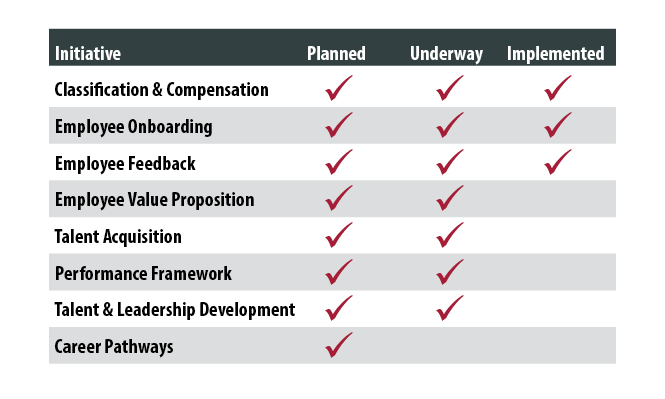
- Classification and Compensation projects including consistently working to align with the market
- Enhancing employee onboarding
- Acting on employee feedback including implementing and responding to Employee Engagement Survey and COACHE survey
- Adopting an ‘Employee Value Proposition’
- Offering full-service talent acquisition support
- Planning and adopting a comprehensive Performance Framework
- Talent and leadership development
- Developing and supporting Career Pathways
Graduate Assistant Support
Yes. In the first phase of the Graduate Assistant Compensation Project, the university increased the minimum graduate assistant base pay rate by approximately 10% on July 1, 2024 (August 12, 2024, for 9-month GAs), and another 10% on July 1, 2025 (August 11, 2025, for 9-month GAs).
In the second phase of the effort, the university is increasing the graduate assistant base wage rate to $25,000 for 9-month doctoral GAs and $21,000 for 9-month masters GAs by July 1, 2027 to help support existing graduate students and attract prospective graduate students.
The university is investing nearly $12 million in both phases of this effort.General Activation Questions
The university has identified several potential financial levers to support the activation including:
- Voluntary retirement option for tenured faculty
- Central and unit-level reserves
- Strategic allocation of revenue streams
- Other operational optimization strategies
- Philanthropy
- Student tuition and fees